What is an urban heat island?
An urban heat island is an area of a city that is warmer than its less built-up surroundings. Asphalt, concrete and stone absorb sunlight during the day and store it. Buildings block the wind and the open sky, so heat escapes more slowly. Traffic, air conditioners and industry add their own heat. Less soil and vegetation also means less cooling from evaporation.
The effect is often strongest at night. As Founda (National Observatory of Athens) and Santamouris explain in a 2017 study, heat stored by the city during the day is released at night, which slows down cooling.
Why nights matter
A hot afternoon is hard on the body. A hot night can be worse, because it removes the chance to recover. The same study notes that research has found high night-time temperatures to have greater physiological impacts than high daytime temperatures. Older people, people with chronic illness and people living in poorly insulated top-floor flats are among those most exposed.
What the studies show for Athens
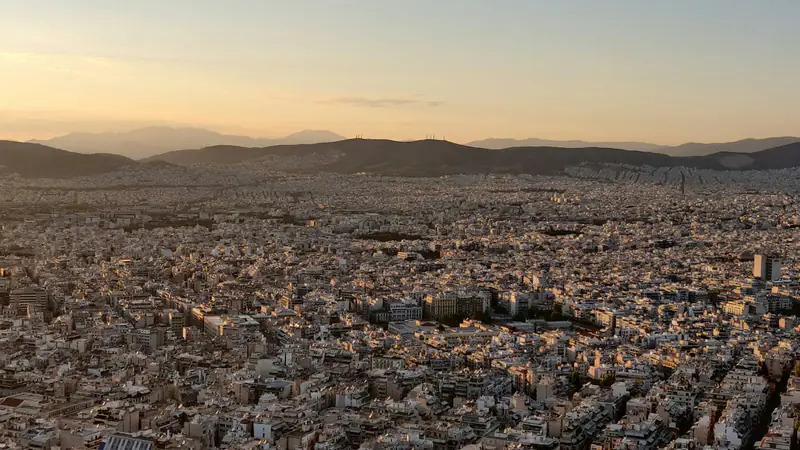
Athens is a useful reminder that heat islands are local and can surprise. Founda and Santamouris compared the National Observatory station in central Athens with several coastal stations during summer 2012, a season with five heat wave episodes. Against these coastal sites, the city's heat island was strongest by day, especially at noon and in the afternoon, which the authors link to sea breezes and the steady temperature of the sea.
The key finding was a feedback between heat island and heat waves. During heat waves, the average heat island grew by up to 3.5 °C compared with normal summer conditions. The night-time difference also rose during heat waves, by up to 1.5 °C at some sites. In short: when the whole region is already very hot, the city adds even more heat.
What the studies show for Thessaloniki
A 2026 study by Christakakis, Aivazidou and Brattich used hourly temperatures from stations in five types of urban area across Thessaloniki, from 2018 to 2022. It found a clear gradient that followed the form of each neighbourhood. The highest monthly heat island intensity, 2.1 °C, was in the urban core. Daily values ranged from −2.3 °C to 2.4 °C in the day and from 0 °C to 2.8 °C at night, with peaks in summer.
Here too, heat waves made things worse, and mostly at night: they raised the night-time heat island by 0.7 to 1.0 °C, most of all in dense urban areas, while daytime values changed little.
What cities can do
The best evidence at European scale concerns trees. A study in The Lancet by Iungman and colleagues looked at 93 European cities in the summer of 2015. It estimated that heat islands raised city temperatures by 1.5 °C on average (population-weighted), and that about 6,700 premature deaths could be attributed to them, around 4.3% of all summer deaths. Raising tree cover to 30% would cool cities by 0.4 °C on average and could prevent an estimated 2,644 of those deaths. The EEA's Climate-ADAPT platform summarises the same study.
Trees are one tool among several. Cities also use:
- Shade over the places people wait and walk: bus stops, school yards, markets.
- Cooler surfaces on roofs, squares and roads, so less heat is stored during the day.
- Water and green space, from small parks to green roofs.
- Air paths that let sea breezes and night air reach the city centre.
- Care for people at night: checks on vulnerable residents and cool places to go during heat waves.
Not every measure works the same way in every street. A light-coloured square with no shade may still be uncomfortable at noon. Results depend on building height, wind, distance from the sea and who lives there, which is why measuring before and after matters.
Where a digital twin could help
Heat islands vary block by block, and the right fix depends on the street. A city-scale twin could combine station data, satellite surface temperatures, building heights, trees and population, and let planners test options before spending money: where would 500 new trees lower night temperatures for the most older residents? We describe this idea on our urban heat island page. Kassandra Labs is at concept stage, and this is a direction, not a finished product.
Sources
- Founda D., Santamouris M., "Synergies between Urban Heat Island and Heat Waves in Athens (Greece), during an extremely hot summer (2012)", Scientific Reports, 2017
- Christakakis, Aivazidou, Brattich, "An observational analysis of the urban heat island in the eastern Mediterranean coast: the case of Thessaloniki, Greece", Environmental Earth Sciences, 2026
- Iungman T. et al., "Cooling cities through urban green infrastructure: a health impact assessment of European cities", The Lancet, 2023
- European Climate Adaptation Platform (Climate-ADAPT, EEA) — Urban greening cools cities and saves lives