What counts as a digital twin
In our plain guide to digital twins we use three tests: the model mirrors one specific real system, it stays connected to new data, and it can be run forward to explore "what if?". The examples below meet those tests to different degrees, and at very different scales. All five are public and described by the organisations behind them.
1. Aircraft: an early definition
One early, precise definition comes from aerospace. In a 2012 conference paper, Edward Glaessgen of NASA and D. S. Stargel of the US Air Force Office of Scientific Research argued that traditional certification and fleet-management methods would struggle with future vehicles that need to be lighter, carry higher loads and last longer. Their answer was a "Digital Twin": an ultra-high-fidelity simulation linked to the vehicle's on-board health monitoring, its maintenance history and fleet data, so that the model follows the life of one specific aircraft.
The key idea is one twin per real object, updated with that object's own history.
2. A factory built virtually first
Manufacturing has embraced twins for planning. According to a March 2023 press release by BMW Group, its new plant in Debrecen, Hungary, was the company's first to be planned and validated entirely in a virtual environment, with virtual production running more than two years before series production. Production layouts, robot placement and logistics were tested in photorealistic simulations built on NVIDIA's Omniverse platform. To feed its factory twins, BMW says it has scanned about seven million square metres of indoor production space and 15 million square metres of outdoor space since November 2020.
This is a company describing its own project, so read the benefits it claims in that light. The method is still instructive: change things in the model, where mistakes are cheap, before changing them in concrete and steel.
3. A whole country in 3D: Virtual Singapore
Virtual Singapore is a well-known city-scale twin. As described by Singapore's Government Technology Agency (GovTech) in 2017, the project is led by the National Research Foundation working with Dassault Systèmes, with topographic data from the Singapore Land Authority and ICT expertise from GovTech.
What makes it more than a 3D map is semantics: the model knows that an object is a building and which surfaces are roofs, walls and windows. That allows analyses such as estimating solar potential or the impact of floods. GovTech also described feeding it with sensor data, such as air quality, temperature and noise, and using it to test projects such as a new highway before building them. That article set the target of government use by 2018; check the official sites for the current status.
4. An open city twin: Helsinki 3D
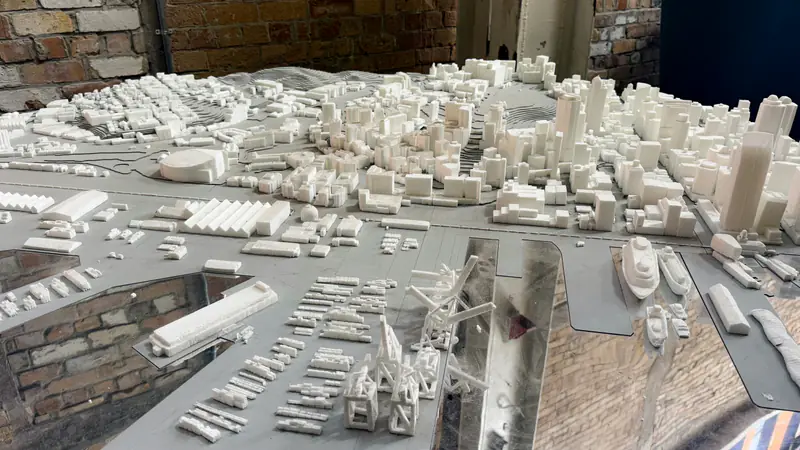
Helsinki shows what a city twin looks like when the data is open. According to the City of Helsinki, Helsinki 3D has two parts:
- A city information model of buildings and terrain in the CityGML standard, with simple or roof-shaped building geometry and identifiers that link each building to other datasets. It is updated continuously.
- A reality mesh built from aerial photographs, which the city says is accurate to within about 20 centimetres.
Both are published as open data under a CC BY 4.0 licence. The city's Energy and Climate Atlas uses the model to estimate solar energy potential on roofs and walls and to simulate heating demand. Helsinki has made 3D building models since the 1980s, and ran a Kalasatama Digital Twins project in 2018–2019.
5. A twin of the planet: Destination Earth
At the largest scale is the European Commission's Destination Earth (DestinE). According to the Commission's policy page, ECMWF builds the digital twins, ESA runs the platform and EUMETSAT operates the data lake. The first two twins cover weather-induced extremes and climate change adaptation. The system was launched on 10 June 2024, after a first phase that began in January 2022, and the stated goal is a "full" digital twin of the Earth system by 2030. The first release was supported by the Digital Europe Programme.
The five side by side
| Example | Scale | Main use |
|---|---|---|
| NASA / US Air Force concept | One vehicle | Health and life of a specific aircraft |
| BMW Debrecen | One factory | Planning layouts, robots, logistics |
| Virtual Singapore | Country / city | Urban planning and analysis |
| Helsinki 3D | City | Open data, energy and planning |
| Destination Earth | Planet | Weather extremes, climate adaptation |
What Greece could take from them
Three lessons stand out. Start from a specific question (an aircraft's life, a factory's layout, a roof's solar yield). Make the data model semantic and, where possible, open, as Helsinki does. And connect local twins to the big European infrastructure rather than rebuilding it. Kassandra Labs is at concept stage and has no projects of its own to list here. The aim is twins built around the questions of Greek municipalities and researchers, on top of open European data.
Sources
- Glaessgen E. H., Stargel D. S., "The Digital Twin Paradigm for Future NASA and U.S. Air Force Vehicles", AIAA SDM Conference, 2012 (NASA NTRS)
- BMW Group — "BMW Group at NVIDIA GTC: Virtual production under way in future plant Debrecen", press release, 21 Mar 2023
- GovTech Singapore — "5 things to know about Virtual Singapore", 2017
- City of Helsinki — Helsinki 3D
- European Commission — Destination Earth policy page